Hyperliquid shows every wallet, position and liquidation price to anyone who looks. Palliora opens each position from a new account, so the trade no longer points back to the trader's wallet. Nobody knows the brand yet, so month one builds one story and one following. Creators join in month two.
230K
active Hyperliquid perp traders at the March 2026 record
BlockEden, Q1 2026 report
500K+
wallets indexed by Hyperliquid copy-trading trackers
HyperX listing, QuickNode
7 of 10
guardians, plus a revoker, needed to open one record
Palliora product page
$250
maximum deposit during launch
Palliora product page
00
The plan in six lines
Audience. Followed traders and size traders first, because a public wallet costs them the most.
X only. The tone is fun and plain, written for traders. The founder's account leads and the brand account supports.
One story. "The trade is public. That it is yours is not," told through jokes, stories and games.
Weeks 3 to 6. A "Why privacy matters" series, founder and team posts, and the first small trader Telegram groups and live streams.
Weeks 7 to 12. A creator chain called "Wallet wrapped" with 3 to 5 trader creators.
Safety. Every public claim is checked against a short "never say" list, and nothing goes out before the team's go signal.
01
Audience and product
Palliora DeFi lets a trader fund a private USDC balance and open each Hyperliquid position from a new account, so the trade no longer points back to their wallet. Traders who get followed or who trade size lose the most from a public wallet, so the plan starts with them.
3 weeks
how often one top market maker rotates strategies because they get copied, per a GoQuant co-founder quoted by CoinDesk
500K+
wallets that copy-trading trackers say they index on Hyperliquid
230K
active perp traders at the March 2026 record, each visible by address with leverage and liquidation price
Priority
Segment
Why a public wallet hurts
What they need to hear
1
Followed traders and CT voices
Followers and copy bots mirror their entries.
They can trade without their audience trading ahead of them.
2
Size traders, small funds and desks
Large positions leak signal and show liquidation levels.
Positions cannot be tied to their wallet, and there is a compliance answer in view keys and guardian disclosure.
3
Strategy and bot operators
The strategy is the product, and the wallet shows it.
Each strategy can run from fresh accounts, and the SDK is available.
4
Wallets, terminals and aggregators
Their users are exposed and they cannot fix it alone.
They can add private trading through the Palliora DeFi SDK.
Segments 1 and 2 come first because they spread the message and fill the pools. Segment 4 starts once there is trader proof to show.
Still public, and said openly
Size, side, entry price and liquidation price on Hyperliquid.
Launch caps of $250 per deposit and $5,000 per pool.
Fees: 5 bps plus a small flat relayer fee, on top of Hyperliquid fees.
Two things to fix before any public push
The docs describe DeFi as testnet only. The product page says mainnet.
The docs say "a completed security audit" and name no auditor.
02
The story: one line, told many ways
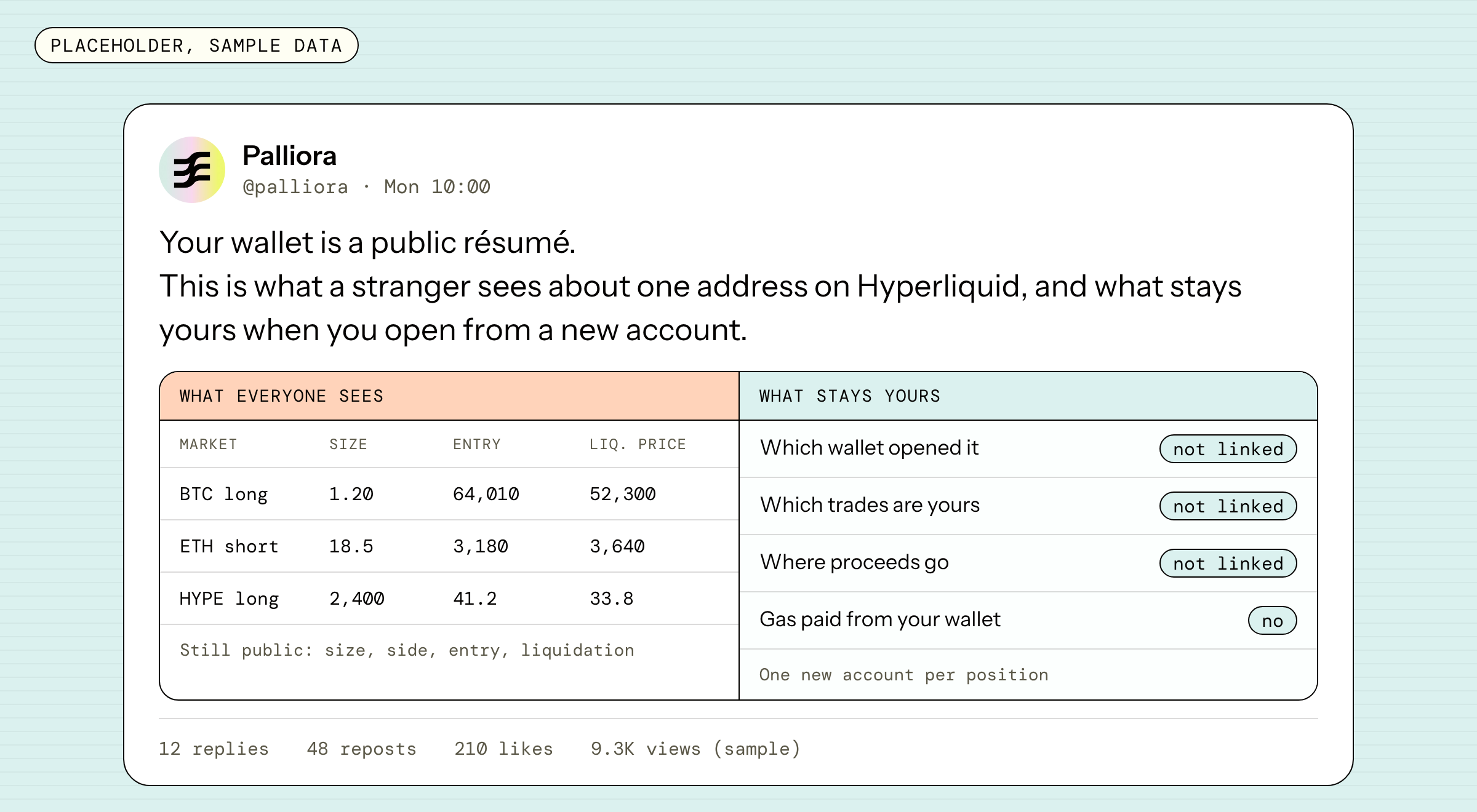
Nobody knows the brand, so the first job is a single idea people remember. The app already says it: "The trade is public. That it is yours is not." The two-panel screenshot below is one handy way to show it. It is a tool, not the whole show.
Placeholder. The two-panel frame, one of several tools. Sample data, not real results.
Bucket 1
Exposed
What trackers and copiers can see about a trader today. Uses the two-panel frame.
Bucket 2
How it works
One idea per post: the private balance, the new account, the guardians, the view key.
Bucket 3
Built in public
The team shares reading lists and build notes, with no product link.
"No master key. One record opens only with a signed public request, a revoker and 7 of 10 guardians."
"Unhackable", "100% secure", "fully audited"
"Size, side, entry and liquidation stay public."
Any return, PnL or "make money" claim
03
Content: founder-led, fun and simple
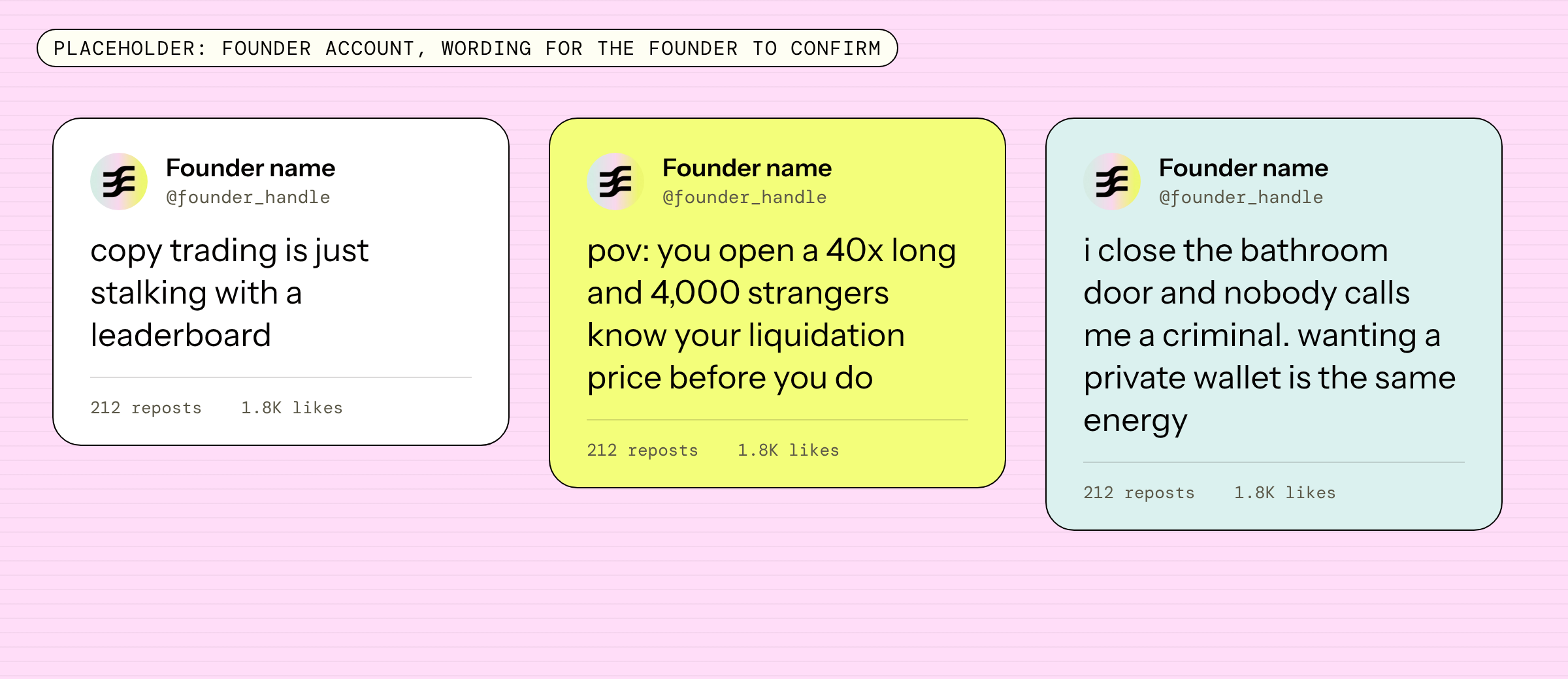
This all goes out from the founder's own account, in a Gen Z voice: lowercase, short, a bit unhinged, written like a trader in a group chat. The brand account reposts and stays quiet. The two-panel screenshot is one tool in the box, not the format. Most of the content is jokes, stories and games that teach privacy by accident.
Placeholder. Founder posts. The founder rewrites every line in their own voice before posting.
The voice
Joke about trader habits, copy trading and the situation. Never about someone who lost money or got hurt.
Memes are made from text, like "pov" lines and "nobody: / copy bots:". No borrowed characters or brand images.
One serious post a month for the real harm, written plainly with no jokes.
Every funny post still teaches one thing, but the joke comes first and the lesson hides inside.
Why privacy matters, told through stories
Storytime
The whale hunt
A trader opens a huge leveraged short. Everyone can see the liquidation price, so the crowd tries to push the price there. Told as a group-chat drama, with no names and no mocking.
Storytime
Hacked is not watched
Two different problems. A leaked key empties a wallet, and that is not something privacy fixes. Being watched is the other one, and that is ours. Saying so out loud builds trust.
Storytime
The unfunny one
Once a month, one plain post on data leaks and physical attacks on crypto holders, then three habits that help: no address in screenshots, no name linked to a wallet, one wallet that is not your main.
Game
Rate my privacy habits
A tier list of everyday habits, such as posting a wallet screenshot or using one wallet for everything. Fun to argue with in the replies.
Game
Bad takes court
The founder gives a verdict on the worst privacy takes from the replies. "Privacy means you have something to hide" gets a trial of its own.
Explainer
Three questions for any privacy product
Who can ever open a record? What stays public? Who holds the key? Then Palliora's honest answers: one record, only with a signed request, a revoker and 7 of 10 guardians; size, side, entry and liquidation stay public; nobody holds a master key.
Games and streams that bring people in
Bit
What happens
Where
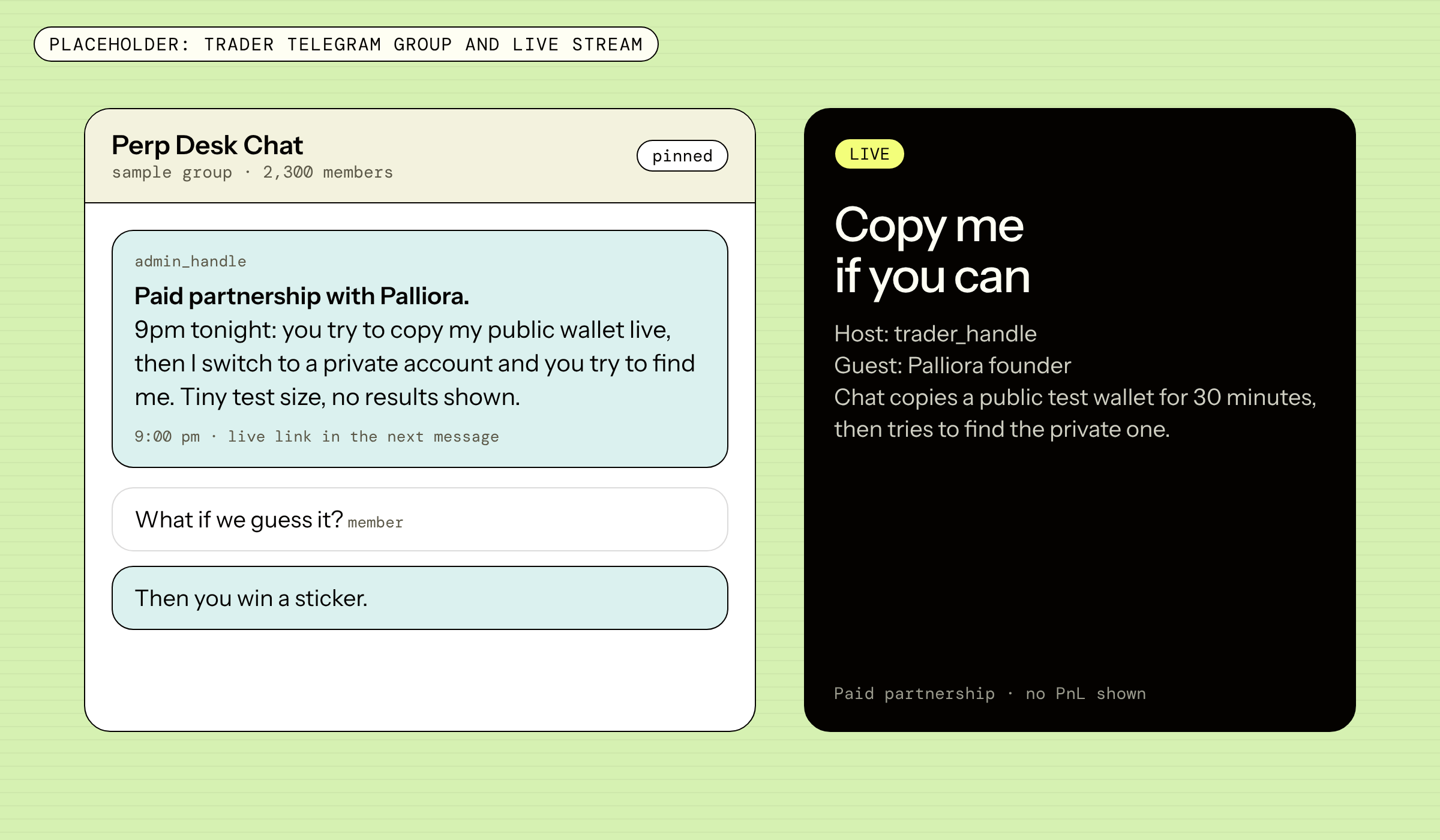
Copy me if you can
The chat copies a public test wallet for 30 minutes with tiny size. Then the founder trades from a private account and the chat tries to find it. Winners get a sticker, not money.
X live, trader streams
Stranger vs my wallet
A friend gets only the founder's public address and ten minutes to guess his trading hours, favorite coins and habits. Own wallet, with consent.
X video, live
Wallet wrapped
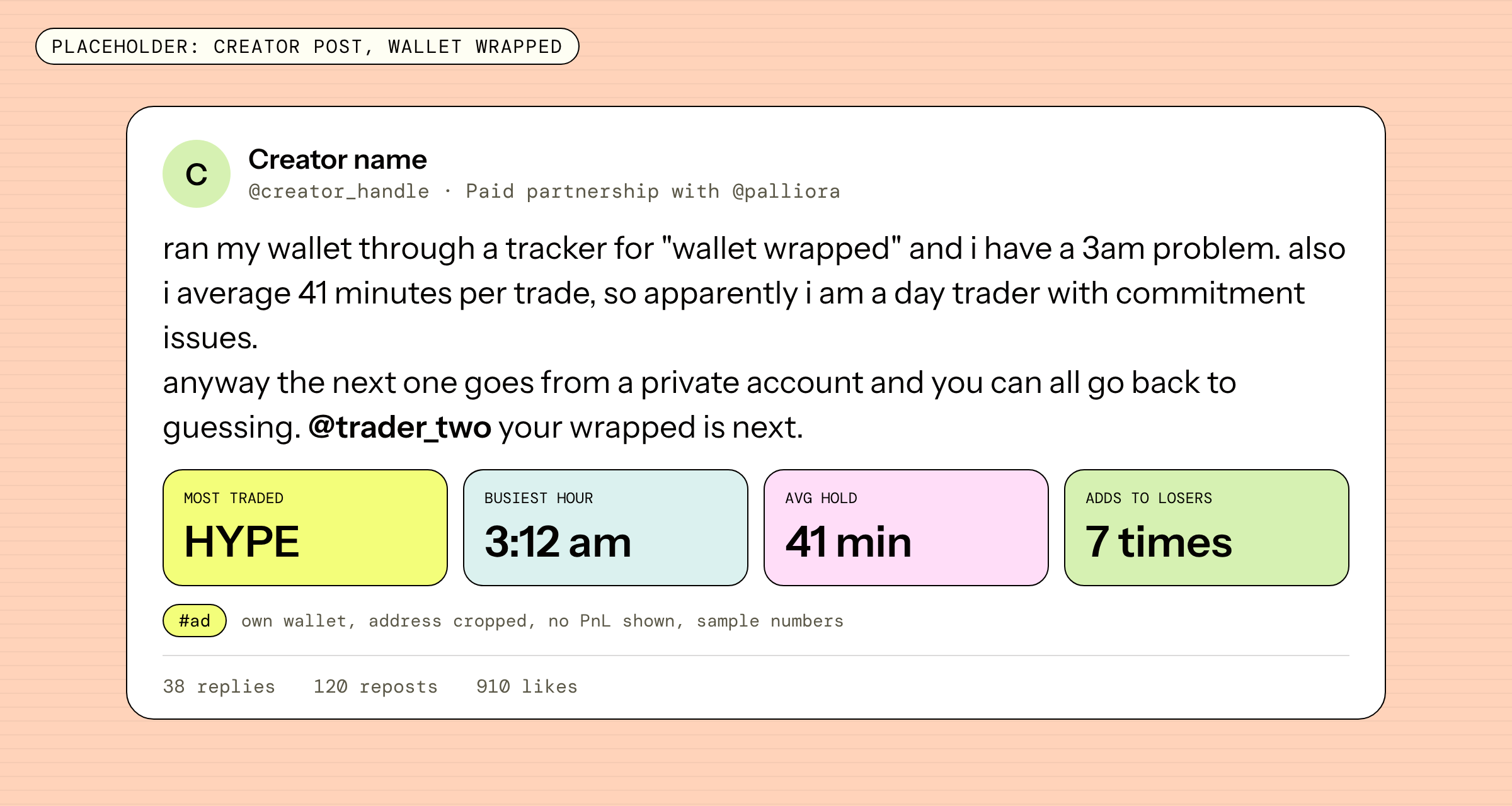
A creator runs their own wallet through a tracker and posts the funny stats: busiest hour, average hold, how often they add to a loser. Then they tag two traders.
Creator posts
Roast my wallet
A trader streamer reads out a wallet's public history like a roast, with its owner's consent. Then repeats it for a private account to show there is nothing to read.
Telegram live, X live
Doxx me if you can
The founder offers a small prize if the chat can link a private test account to him. A stunt for later, once the product has held up in public.
X, month 2 or 3
The top-of-funnel series: why privacy matters
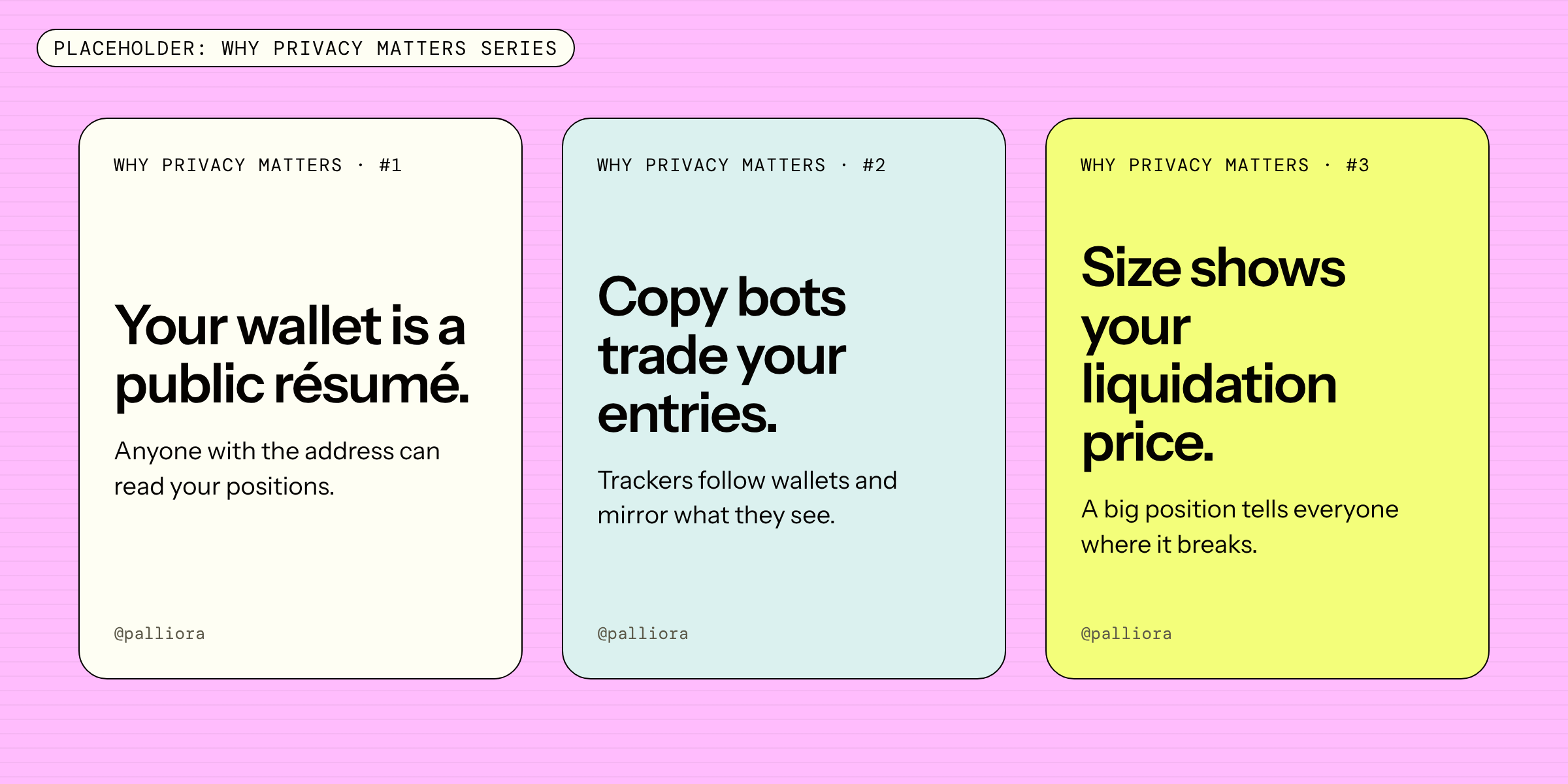
Ten short episodes, three a week for about four weeks, one card each with two lines of text. The first five have no product link. The best two or three get a second run with a new hook.
Placeholder. Episodes 1 to 3. Your wallet is a public résumé, copy bots trade your entries, size shows your liquidation price.
Later episodes cover how strategies get copied, what stays public even with Palliora, how a record can be opened, what a private trade costs, and the best questions from the replies.
Founder and team habits
Weekly
One opinion, 40 seconds
The founder talks to camera about one view on privacy.
Weekly
Ask the cryptographer
Three questions from the replies, answered in plain words.
Weekly
Build note and reading list
An engineer shows something being built. The team shares three links, with no Palliora link.
Always
Fix it in public
If a post was wrong or something breaks, the fix goes out the same day.
RuleOwn wallets or consenting people only, no home addresses, no real names of third parties, no PnL shown and no return claims. Say "paid partnership" whenever it is one. Never say anonymous or untraceable.
04
Trader Telegram groups and live streams
Traders already trust a handful of people who run Telegram groups and live streams where they talk about trading apps. FOMO and other brands pay for this at a very large scale. Palliora starts with small groups and streamers, because a new brand cannot match big budgets and a small trusted group will still try something new.
Placeholder. A pinned paid-partnership message in a small trader group and the live teardown it points to.
Tier
Who
When
What they do
Start
Admins of Telegram groups with about 500 to 5,000 members, and small live-stream traders
Weeks 3 to 6, three to five of them
One live wallet teardown with a Palliora engineer, plus a pinned message
Grow
Ten to twenty similar groups and streamers who responded well
Weeks 7 to 12
Their own wallet check on stream, a Q and A, a repeat show
Later
Large groups and trader creators
After the numbers are good
The "Wallet wrapped" chain below
Format 1
Live wallet teardown
The host runs their own wallet through a tracker live, then repeats with a private sub-account. The audience sends their own wallet checks.
Format 2
Pinned message and Q and A
The admin writes a short pinned post in their own words. The Palliora engineer joins the group for one hour to answer.
Format 3
Small early-access seats
Each group gets a handful of early-access spots, which suits the launch caps and makes it feel exclusive without a big reward.
How to run it
One brief page per partner with the claims table and the do-not-say list.
Every paid post says it is a paid partnership, in the group and on the stream.
No results, no PnL, no signals, and no return claims.
Each group gets its own link or code, so the team can see which ones bring people in.
Check the regions with counsel first, especially for the US and China.
Pay a flat fee per show. Do not pay per signup until the rules for the region are clear.
05
Creators: the "Wallet wrapped" chain
Weeks 7 to 12, once the account has a clear story and people who follow it. Creators then join something that already exists, so their posts have a frame to copy and an audience to land in.
Creator runs their own wallet wrapped→Posts the funny stats→Tags two traders→They do the same
3 to 5 creators at first
How a creator post works
The creator runs their own wallet through a tracker and picks the funniest stats: busiest hour, average hold, how often they add to a loser.
They post it in their own voice with a paid-partnership disclosure. No PnL, address cropped.
They tag two other traders, who run their own wrapped.
The team clips the best 30 seconds and reposts it. Each week one creator takes over the main account for a day.
GuardrailNobody posts results or PnL, and no brief scripts a return claim. This keeps it clear of return claims and gambling-style rules, but counsel should still check regions.
Placeholder. A wallet wrapped creator post. Sample numbers.
Same time
Early-access cohort
25 to 50 followed traders and size traders, invited by X handle or email in weeks 5 to 8. Palliora's Discord answers their questions.
Same time
Front-end partners
Three to five terminals, wallets and aggregators to talk to about the SDK, once there is trader proof to show.
Later
"Trace us"
A bigger stunt, in the style of Propr's public challenge page. The team trades small from private accounts and the public tries to link them to the team. It tests the product in public, so it needs engineering sign-off and a go signal first.
Propr, a prop firm on Hyperliquid, uses the same pattern: ask a question, post a screenshot, get a reward. Palliora's version swaps the reward for being part of a chain.
06
First 90 days
Three phases. Each phase starts when the previous gate is met.
Weeks 1–2
Phase 0, prepare
Messaging document and claims table approved
App and docs reviewed, testnet and mainnet wording fixed, auditor named
First series cards and founder posts drafted
Reply list of 30 to 50 voices built
15 days of content drafted
GateThe team signs off the claims table and gives the go signal.
Weeks 3–6
Phase 1, build the story
Profile, pinned post and daily replies
Founder and team voices, "Why privacy matters" series
First small trader groups and live streams
Founder videos every week
GateThe account has a recognizable frame, the reply list is engaging back, and there is no open security issue.
Weeks 7–12
Phase 2, creators and cohort
"Wallet wrapped" chain with 3 to 5 creators, then 8 to 12
25 to 50 early-access traders onboarded
SDK talks with 3 to 5 front-ends
Palliora AI messaging drafted, no public push until a mainnet date exists
GateUsers per pool and repeat use are both rising, and one integration is live.
Day
Post
Monday
Founder joke or story post
Tue, Thu, Sat
"Why privacy matters" card
Wednesday
Reading list or build note
Friday
Founder clip or live session
Every day
Team replies to 30 to 50 trader voices
07
Measurement and budget
Privacy improves as more people use a pool, so the main numbers are users per pool and repeat use. Targets are set after two weeks of baseline data.
Metric
What it shows
Source
Saves, shares and replies on series posts
Which version of the story people repeat.
X analytics
Funded private balances per week
Demand is reaching the product.
Aggregate on-chain pool data
Second position within 14 days
Repeat use, the main sign of trust.
Aggregate app counts
Users per pool and deposit size mix
Privacy quality. A pool of 20 users is thin, and this number shows when more reach helps.
Aggregate on-chain pool data
Unbriefed posts about Palliora by trader accounts
Whether the message travels without help.
X search, checked by hand
Marketing tools hold aggregates only, with no wallet-level profiles.
Budget. The monthly program budget is still to be confirmed with the team, so this is a proposed split by share. Dollar amounts follow once the figure is agreed.
Trader creators
Flat fees and early access, from phase 2
40%
Video and tools
Founder video, app recordings, tools
30%
Reserve
Reactive moments and the cap-lift announcement
20%
Design and scheduling
Card templates, editing, scheduling
10%
08
Open questions
These need an answer from the team before phase 0 closes.
Are the launch caps ($250 per deposit, $5,000 per pool) still in force, and when do they lift?
Who audited the contracts and when, and can the audit be named publicly?
The docs say DeFi is live on testnet only and the product page says mainnet. Which is current, and who updates the docs?
Which pool holds the funds for Hyperliquid trades, Ethereum or HyperEVM? The product page says each chain has its own pool.
Which regions can marketing reach, according to counsel?
Who on the team can join a weekly recorded call, and who approves technical claims before a post goes out?
 Palliora trader plan